 tháng 6 08, 2013

Do you see her? just above the window sticker :)
And I have to giggle, because the sheep farmers out here will “tag” their sheep by painting a spot on their wool in a certain color as a marking to show their ownership, or if this sheep has been vaccinated, or perhaps if this sheep has been bred.
One lady on the bus asked “Why are these sheep blue?”
And our driver, Noel –didn’t skip a beat! He said in the most marvelous Irish brogue ever heard…”Those are special sheep –reserved for making BLUE SWEATERS!”
And we all laughed ourselves silly.
The next little bit down the road there were sheep roaming around bearing pink markings…and someone was heard to yell out – “Look! PINK SWEATERS!!” It’s all too fun, and we love seeing the sheep wandering along their way, even if it means we fear for their lives when they get in the road and we have to slow down.
What do you get when you cross a blue sheep with a pink sheep? PURPLE sheep! :cD

We were on our way to Kylemore Abbey, about 2-1/2 hours outside of Galway, toward the mountains.
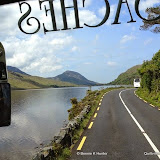
See that raised terrain on the right? PEAT! Peat is a traditional Irish fuel source, the product of thousands of years of plant life that had grown and died, grown and died, grown and died layer upon layer until the earth is a spongy mass of vegitation. The peat is cut and dried in the sun until it is rock hard and burnable as heating and cooking fuel.
Noel stopped the bus, ran out…..picked a brick of peat from the pile and ran it back over to us so we could examine it. This is SNEAKY PEAT!

It’s not as heavy as it looks…but it is dry and hard and it burns a slow smoldering heat.
Peat isn't used as much for fuel now as it was in the past. Peat fields are being preserved because when the peat is gone, the peat is gone…it will take hundreds of thousands of years of plant life for it to build again.
Peat may not look like the most wonderful thing, but it kept many a family warm and dry and fed through many thousands of years of life here in Ireland.
It sure beats gathering buffalo chips for fuel, doesn’t it?

Further up the road we turn into Kylemore….and this view takes my breath away.
The story of Kylemore is as follows:
((Courtesy of Wikipedia!))
Kylemore Castle was built as a private home for the family of Mitchell Henry, a wealthy doctor from London, whose family was in textile manufacturing from Manchester, England. He moved to Ireland, when he and his wife, Margaret, purchased the land around the Abbey and became a politician, and was also an MP for County Galway from 1871 to 1885.

The castle was designed by James Franklin Fuller and Ussher Roberts. Construction first began in 1867, and took one hundred men four years to complete. The castle covered approximately 40,000 square feet (3,700 m2) with over 70 rooms and the principal wall was two to three feet thick. The facade measured 142 feet (43 m) in length and is made of granite brought from Dalkey by sea to Letterfrack and limestone from Ballinasloe.

There were 33 bedrooms, 4 bathrooms, 4 sitting rooms, ballroom, billiard room, library, study, school room, smoking room, gun room and various offices and domestic staff residences for the butler, cook, housekeeper and other servants. Several other building including a Gothic cathedral and family mausoleum containing the bodies of Margaret Henry, Mitchell Henry and a great grand nephew.

The Abbey remained in Henry's estate after he returned to England, and the castle was sold to the Duke and Duchess of Manchester in 1909, they resided there several years, before being forced to sell the house and grounds due to gambling debts.

In 1920 the Irish Benedictine Nuns purchased the Abbey castle and lands after they were forced to flee Ypres, Belgium during World War I. Previously the nuns, who had been based in Ypres for several hundred years, had been bombed out of their Abbey during World War I. The nuns continued to offer education to Catholic girls, and opened an international boarding school and established a day school for local girls. They were forced to close the school in June 2010.

The Estate includes large walled Victorian Gardens, which have been open since the 70s, to public tours and 'nature' walks. The Benedictine community have restored the Abbey's gardens and Cathedral with donations and local artisans, in order to be a self-sustaining estate.

The grounds were unbelievably lovely, and I found myself wandering…from the house…up the manicured lane to the memorial chapel that Mitchell Henry had built in honor of his wife, Margaret. From there I wandered further on to the mausoleum that inters them both.
There are too many photos and I love them all…it was SUCH a beautiful day and the lake mirrored everything in perfect splendor.
There are loads of photos in the slide show below, including a lot of duplicates or photos of a slightly different angle and I wanted to keep them all in one album.
Click the image below to view the photos directly in the album if you can not view the slide show on your mobile device.
 |
| Kylemore Abbey, Ireland 2013 |


Không có nhận xét nào
Đăng nhận xét